
When Welsh Was the Language of Princes and Poets
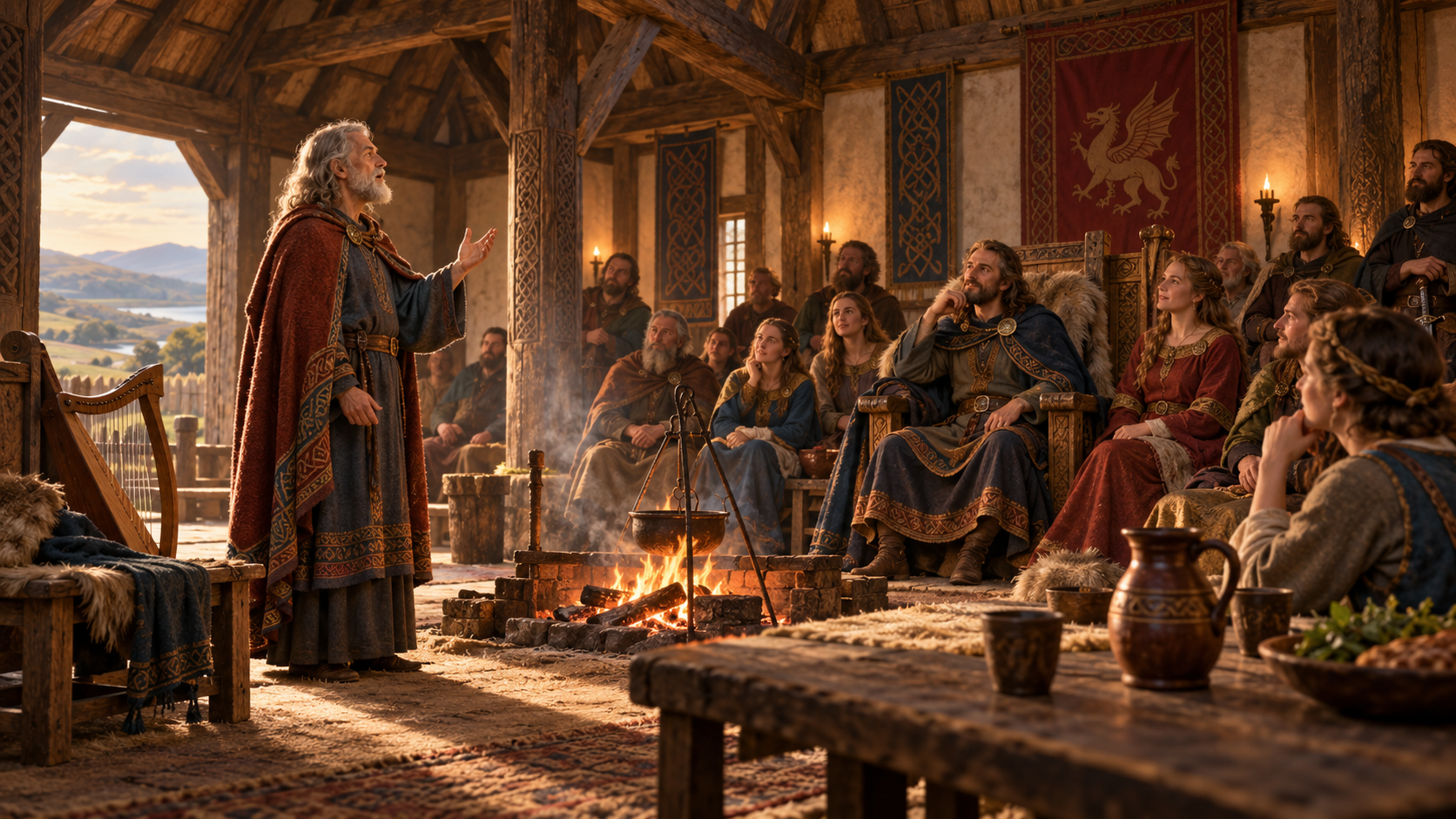
Imagine a medieval Welsh hall with a fire burning while a prince sits among his household as a bard rises to speak. His words celebrate courage, ancestry and generosity. They may also warn an enemy or remind his patron of a ruler’s duties. Those words are in Welsh.
We often hear medieval Britain described through the Latin of the Church, the French of the aristocracy and the gradual rise of English. Yet Welsh had its own distinguished place in this world.
Professor Helen Fulton explores this in her chapter on the status of Welsh in The Land Beneath the Sea: In Honour of Anders Ahlqvist. Her research reveals a language that carried authority, learning, and cultural confidence through centuries of political change.
A voice in the royal hall
After the Norman conquest of England, French became the prestigious language of the ruling elite there. In Wales, Welsh remained the language of native princes and nobles, as well as much of the wider population. It belonged not only to the rural folk, but also to the sophisticated poetry performed before rulers.
In verses outlining how he would be remembered, the bard would celebrate his prince’s victories, honour his ancestry and reflect on his generosity. Reputation mattered deeply, and poetry held political weight.
Fulton describes twelfth-century Wales as home to one of Western Europe’s flourishing traditions of court poetry. Welsh was a language in which power could be celebrated and expectations placed upon those who held it.
A world of many languages
Welsh was the main language of the twelfth century, but a Welshman also heard Latin, French, English, Irish and Flemish. Which language someone used depended on their circumstances and audience. A prince might listen to poetry in Welsh while his correspondence might be written in Latin. French could open doors to Anglo-Norman aristocratic and administrative circles, and English became increasingly useful in towns and trade.
People able to move between languages enjoyed considerable advantages, although many others probably spoke only one. For a historical novelist, these encounters offer intriguing possibilities. Who understands a whispered exchange? Who needs an interpreter? Who must trust another person to convey a message faithfully? Language could influence a negotiation as surely as wealth, rank or military strength.
Stories that kept Wales at the centre
Welsh literature reveals a culture deeply conscious of its own past. In the native prose tales, including the Four Branches of the Mabinogi, Welsh and British rulers occupy the centre of the story. Their families, feuds and obligations shape the world around them.
Although the bard’s poetry often praises conflict and resistance to English armies, and works written for various Welsh princes shared a common identity, the Welsh rulers themselves were often bitterly divided. The bards also incorporated French romances and Latin histories, which were translated into Welsh, allowing readers and listeners to encounter other traditions in their own language.
When power changed hands
Later, Edward I’s conquest of Wales in the thirteenth century removed the native princely leadership that had supported Welsh court culture. The Welsh gentry, known as the uchelwyr, continued to patronise bards and manuscripts, so the Welsh literary world continued. The world changed swiftly, however, as English-speaking merchants held advantages in growing towns, while official administration increasingly operated in languages other than Welsh. When the monasteries floundered under the dissolution, Welsh literature suffered a further blow.
Bringing that world to life
This is part of what makes medieval Wales such compelling ground for The Welsh Warrior Series. Behind the struggles for kingdoms lay a richly expressive world: poetry before a prince, stories shared within a household, private words of affection and public declarations of loyalty. Language carried ambition, humour, grief and love.
In writing the series, I seek to bring readers close to the people within that world, their hopes, divided loyalties and difficult choices. Each of the five novels stands alone, offering a different journey into a history whose human passions still feel familiar.
Fulton’s research reminds us how much there is to discover when we listen to medieval Wales in its own voice.
Explore The Welsh Warrior Series here.
With thanks and credit to Professor Helen Fulton, whose chapter on the status of Welsh in The Land Beneath the Sea: In Honour of Anders Ahlqvist provides the basis for this article. The reflections on historical fiction and The Welsh Warrior Series are my own.