
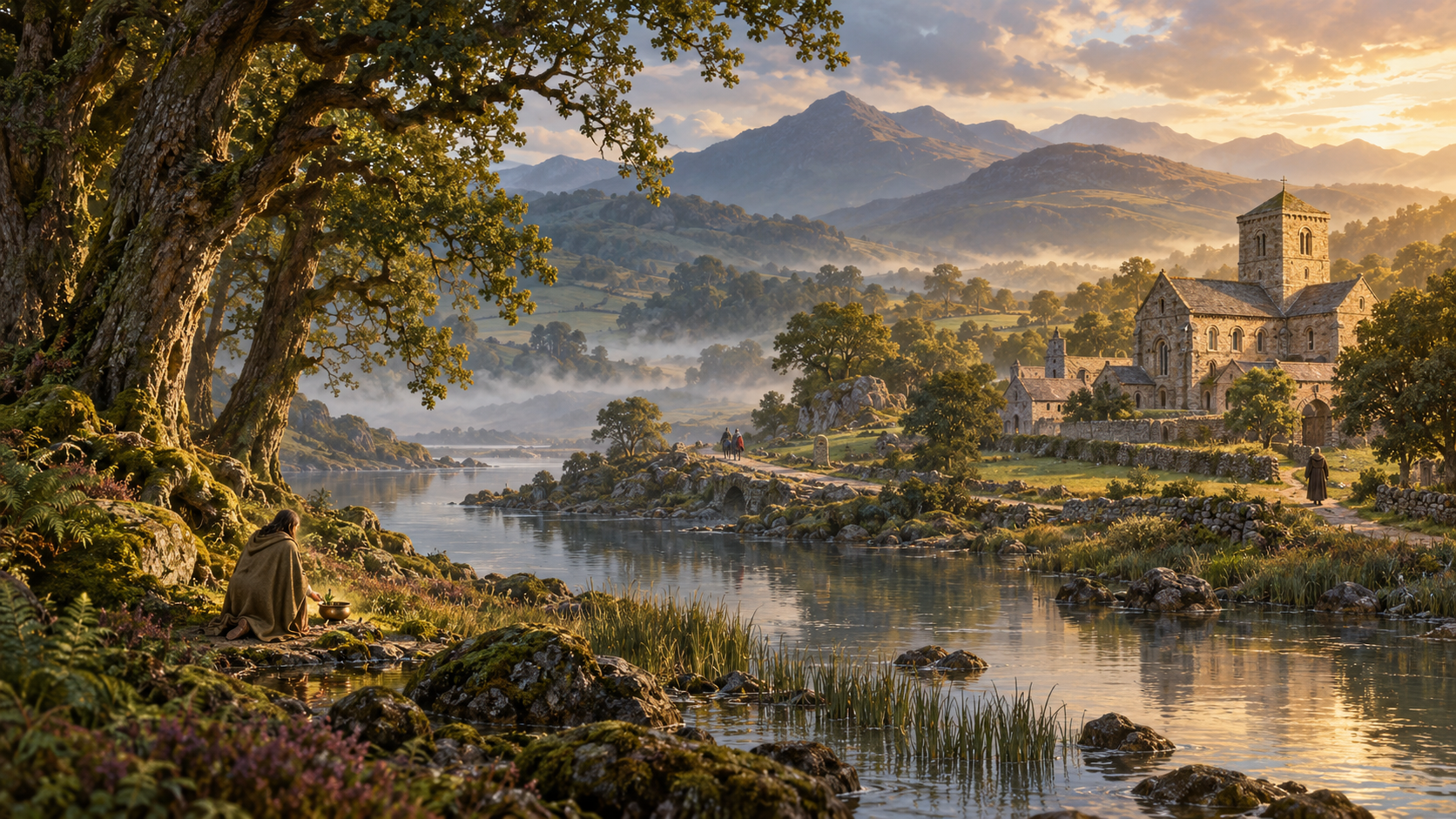
The saints’ names Welsh churches bear, the ruined abbeys that stand, and the place names give us clues about ancient religious communities, yet we know relatively little about the early history of Christianity in Wales. I was therefore interested to explore A History of Christianity in Wales, by Barry J. Lewis, Madeleine Gray, David Ceri Jones and D. Densil Morgan, which provides a fascinating starting point for exploring this history, especially the early chapters revealing a religious landscape shaped by local loyalties, conquest and connections across the sea.
The sacred world before Christianity
When Roman armies entered the lands we now call Wales, they encountered people with religious beliefs and practices. Sacred groves and waters formed part of their spiritual landscape, while druids belonged to an influential learned tradition.
Classical writers described druids as religious authorities, teachers and interpreters of the natural world. Some accounts also describe divination and sacrifice, including human sacrifice. These descriptions require caution: outsiders, sometimes hostile ones, supplied much of our written evidence.
The Roman Tacitus tells us druids raised their hands and uttered curses as Roman soldiers approached them on the island we now call Anglesey, while torch-bearing women moved among the defenders. It is a vivid account, yet perhaps biased by Roman politics.
Archaeology offers another glimpse. At Llyn Cerrig Bach on Anglesey, weapons, tools and chariot equipment were deposited in a lake over several centuries, apparently as offerings. People deliberately surrendered valuable possessions to sacred waters. Although often associated with druids, the objects cannot tell us precisely who conducted the ceremonies or what words accompanied them.
The Romans brought their own gods and rituals. Native and imported traditions mingled, creating a varied religious world in which Christianity would eventually take root.
A conversion without a single founding moment
We know Christianity reached Britain in Roman times, but its earliest development in Wales is difficult to trace. There is no single Welsh conversion story, for example, that compares with Ireland’s association with St Patrick.
Its influence survives in the language. Welsh words such as eglwys, meaning church, and esgob, meaning bishop, have Latin roots: small reminders of a profound cultural change.
By about 600, rulers and aristocratic families had embraced Christianity, although access to churches remained uneven. Religious life included wealthy communities, austere island settlements and solitary hermitages. Even those seeking withdrawal from worldly affairs depended on land and patronage, keeping them connected to powerful families.
Saints and a Christian landscape
Saints such as David, Teilo, Cadog and Beuno became central to religious identity. Their names linked communities to particular churches and places.
Lewis challenges the idea of a single, separate “Celtic Church”. Welsh Christianity possessed distinctive customs, including differences over calculating Easter, while remaining within the wider Christian tradition.
Before the Normans arrived, important churches supported communities of clergy called clasau. The clasau held estates, maintained dependent churches, and worked together for the benefit of all.
Conquest, reform and the medieval church
From the late eleventh century, Norman expansion brought upheaval alongside reforms concerning religious appointments, clerical celibacy and monastic discipline. Madeleine Gray emphasises that these changes also belonged to developments across European Christianity.
New religious houses appeared while Welsh shrines and customs endured. By the end of the twelfth century, Wales belonged firmly to western Christendom, retaining powerful local traditions.
Faith in the Welsh Warrior Series
This changing religious world also appears in my Welsh Warrior Series, set against the history of the late eleventh and twelfth centuries. Faith shapes the world the characters live in, alongside love, ambition, family loyalty, and power struggles.
When we think of Welsh history, we often think of battles and castles, but religious history helps us add more flesh to what we know about Wales in early times.
Further reading Barry J. Lewis, Madeleine Gray, David Ceri Jones and D. Densil Morgan, A History of Christianity in Wales (University of Wales Press, 2022), especially chapters 1–5. The discussion of druids also draws on Amgueddfa Cymru–Museum Wales and the archaeological evidence from Llyn Cerrig Bach.