
What Would North Wales Have Looked Like in 1093?
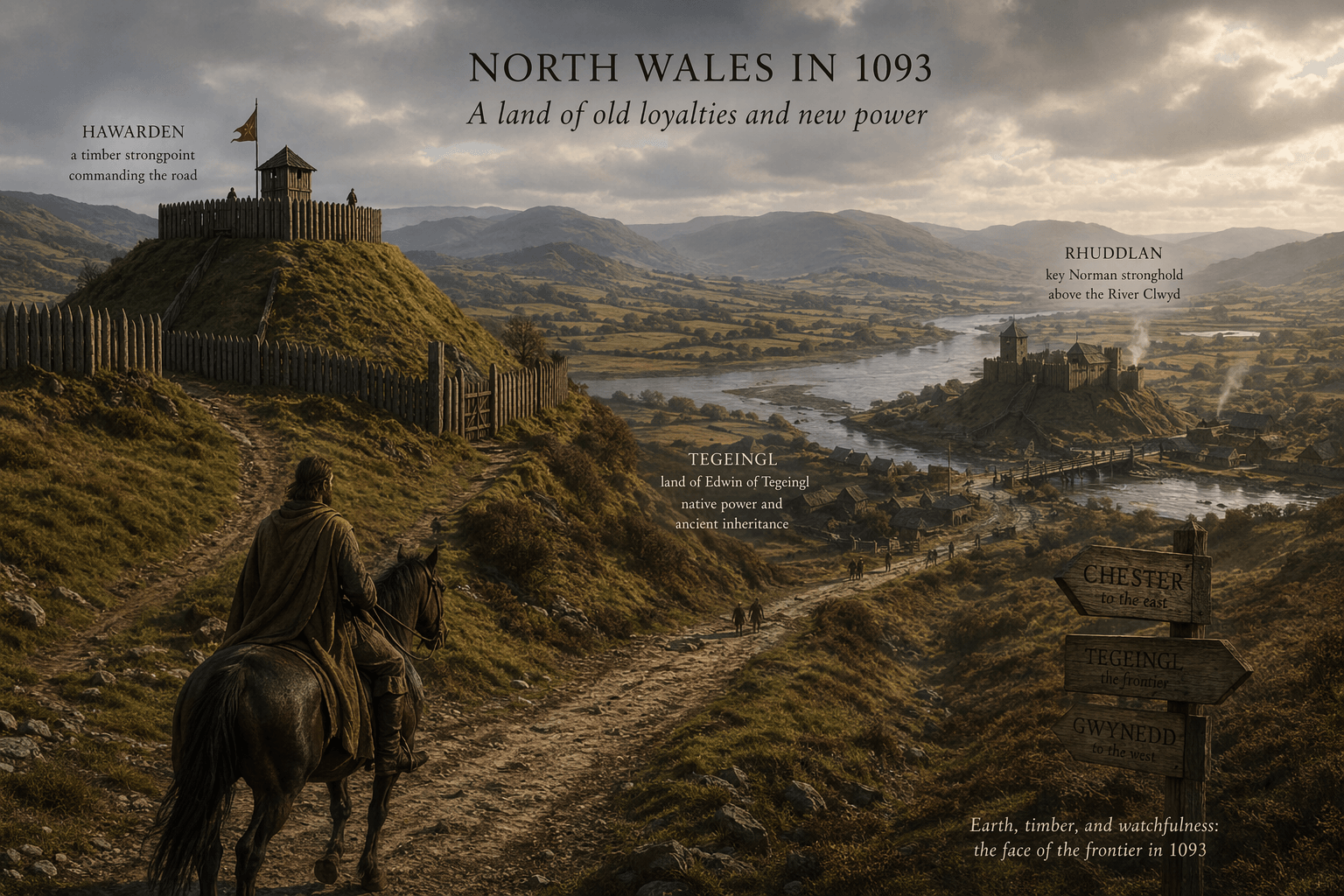
I am often asked what North Wales in the late eleventh century would really have looked like, and whether the Norman presence would have been obvious to anyone travelling through it. It is a question I particularly love, because it asks us to look beyond the later stone castles and the neat certainties of hindsight, and instead to picture a country in transition: beautiful, formidable, and deeply unsettled.
It matters to me for another reason, too. This is the landscape that shaped the people who walk through my novels. Among them is Edwin of Tegeingl, grandfather of Angharad, the heroine of The Welsh Traitor’s Daughter. When we think of north-east Wales in this period, it is worth remembering that long before the Normans raised their mottes and palisades, this was already a land of native rulers, inherited loyalties, royal courts, and ancient claims to power.
So what would a traveller have seen in 1093 if he rode west from Chester towards Gwynedd?
Not, I think, a land wholly conquered. Nor a land untouched. He would have entered something far more uneasy than either: a frontier where the old world still endured, but where a new and aggressive power had begun to impose itself at the most vital points.
The change would begin almost as you left Chester, already one of the great Norman frontier capitals from which the earls of Chester pressed their ambitions westward soon after 1066. Their advance into Wales was driven by force, opportunism, and castle-building. These were men who had left Normandy to gain advantage and wealth, and their fortifications stamped that desire on the landscape. The Normans spread not evenly across the countryside but by seizing roads, crossings, estate centres, and places of older importance.
This is where our modern imagination can mislead us. We are so used to the great castles of later Wales that it is tempting to imagine the eleventh century as a time of towers of dressed stone and mighty concentric walls, yet in 1093, what you would mostly encounter were earth-and-timber fortifications. Usually, these were steep mottes topped with wooden palisades, rough towers, ditches, banks, and armed men watching the road. These were functional but not with the stone permanence of later years.
The first sign of Norman dominance would likely be Hawarden. Not the later castle whose ruins still survive, but an earlier strongpoint commanding the approach from Chester into north-east Wales. The hill it stood on had mattered before the Normans ever came, which is why they took it. Normans chose places that already mattered. They did not invent a new geography. They occupied the old one and forced it to serve them.
A traveller approaching Hawarden in 1093 would not have seen the exposed defended height with solid timber works stark against the sky. There would be watchmen. He would have understood at once that the road west was no longer merely a road, but something observed and controlled.
Beyond Hawarden lay Tegeingl, and here the atmosphere would have sharpened further. This land was associated with Edwin of Tegeingl and his descendants, a place with its own native prestige and political memory. For me, the characters in my books, Edwin’s descendants, remind us that the Welsh landscape was already vibrant with meaning before the Normans arrived. The conquest did not begin upon a wasteland.
By 1093, Norman influence at Tegeingl would have been unmistakable, and I try to show this in my books. Some facets of Welsh life continue as they have for generations, but men are always looking over their shoulders. Not everywhere, perhaps, but at the vital points. The region had begun to acquire a network of castles and smaller watch-sites, designed to hold the country not by smothering it, but by pinning it at the joints. Roads, crossings, estuaries, old courts, high enclosures, and river valleys became the places where Norman presence declared itself most plainly.
A rider might not pass beneath a major fortress every few miles. Owain ap Edwin takes a journey to Chester, where we see what is happening on the agricultural land, and although he is going for a meeting with his Norman overlord, what he sees is what has happened on the land for many generations.
A rider might not feel Norman presence everywhere. Still, it would likely feel the existence of lesser outposts: smaller mottes, lookout sites, and garrisons stationed where they could keep watch over movement. The land would have felt less settled, more wary. This was not yet the heavy, finished hand of conquest. It was the taut vigilance of a frontier still being made.
Sooner or later, that road west would bring a traveller to the great fact of Norman power in the region. Rhuddlan, built above the River Clwyd, was the key stronghold, the place where the changing landscape would have become impossible to ignore. It commanded the lower valley, the crossing, and the route further west. If Hawarden warned you, Rhuddlan told you plainly that the Normans had pushed deep into north-east Wales. Angharad would have seen and heard of the impact of Robert of Rhuddlan every day as she grew up, and he was indeed a brutal man.
Yet Rhuddlan, too, speaks of continuity as much as conquest. This was not simply a place the Normans chose at random. It had earlier significance, connected with an Anglo-Saxon burh and later with Welsh royal power. That is one of the things I find most compelling about this period. The Normans did not so much erase the older landscape as seize hold of it. They took places already rich in authority and memory, and recast them in ditch, bank, timber, and force.
That, I think, is what would have been most striking to a traveller in 1093. The land would still have felt profoundly Welsh. Its old territorial divisions, loyalties, and memories were not gone. Men such as Edwin of Tegeingl belonged to a world that still echoed through the country, but over it now lay something new and disquieting: surveillance, armed occupation, coercion, and the visible symbols of an intrusive power that had not yet fully settled, but had already altered the feel of the road.
West of Rhuddlan, towards Gwynedd, the mood would have changed once more. Behind lay the denser belt of Norman influence. Ahead lay a country that was less securely held, more resistant, and far from quiet. Norman power had expanded enormously since 1066, but in 1093 it was still vulnerable, still dependent on force of personality and military pressure, and still capable of being broken. That same year saw the death of Robert of Rhuddlan, whose career had done so much to extend Norman authority in the north-east. His fate is a reminder that this was not a finished conquest, but a dangerous and contested one.
So when I am asked whether the Norman presence in North Wales would have been obvious in the late eleventh century, I do not think so in the way we often imagine as a settled world of stone keeps and unquestioned rule or as a landscape remade so completely that the older Welsh one had vanished beneath it. Rather, it is a pressure and intrusion. There was a sense that at certain key places the road itself had changed hands.
If you travelled from Chester to Gwynedd in 1093, you would have seen enough to know that the world was changing. You would have seen timber strongholds on commanding heights, armed men where once there had been only native courts and local powers, and the beginnings of a frontier system tightening across north-east Wales. You would also have known this: the change was not complete. Beneath the new Norman layer, the older land still endured, watchful and unconquered in spirit.
Perhaps that is what fascinates me most about North Wales in this period. It was not yet one thing or the other. It was a country caught between memory and invasion, between inheritance and imposition, between what had long been and what was now forcing its way in. For a novelist, I can think of few settings more compelling.